
Last updated on November 10th, 2026

League tables and fixture tickers present Fantasy Premier League (FPL) managers with two ways of looking at teams. A club’s Premier League position records its place in the competition so far, based on points earned. The Fixture Difficulty Rating (FDR) beside an upcoming match assesses the opposition in that fixture. Their numbers answer different questions about the same football calendar.
A win earns the same league points regardless of the opposition, so the table does not separately weight victories by the strength of the teams beaten. A strength rating can take a different approach, using the level of opposition to interpret a result. The difference lies in what each measure is designed to recognise.
Results and opponent strength
It may help to look at how this can be done differently to better understand it; in the case of certain esports, win rates do take into account difficulty levels, which can offer more information about how a team is doing in real terms. When comparing the top Counter-Strike teams today, for instance, the quality of the opposition helps explain a team’s results. Victories provide evidence, while an opponent-adjusted rating distinguishes between them according to the level of the teams beaten. It assesses competitive strength through the results and the opposition together, rather than treating every victory as equally informative.
ESL’s Live Ratings rules for 2026 describe this approach. Adjustments account for the relative strength of the opponents and the match scoreline, with victories over higher-rated teams carrying more weight than victories over lower-rated teams. It shows why recording results and assessing competitive strength are different tasks. FPL takes a very different approach, and simply marks wins, not opponent strength.
League position also describes an order without expressing the distance between clubs. The points totals provide that additional information. Reading position as a strength measure therefore requires care: moving one place through the table does not represent a fixed change in the quality of opposition.
FDR uses a scale from 1 to 5, with lower numbers indicating easier perceived fixtures. It summarises assessed difficulty on its own scale. The difference between rating categories does not specify an amount of additional fantasy scoring or predict a particular player’s return.
Two schedules with the same reported FDR
The Premier League’s remaining-fixtures comparison on 8 April 2026 set two football measures alongside each other: average remaining FDR and the average league points already accumulated by each club’s remaining opponents. Arsenal and Manchester City had the same reported average FDR, while the opposition-points figures differed.
| Club | Remaining fixtures | Reported average FDR | Opponents’ average league points |
| Arsenal | 7 | 2.9 | 40.0 |
| Manchester City | 8 | 2.9 | 45.6 |
These were figures from that date in the 2025/26 season. City had an additional match remaining, and the FDR averages were displayed to one decimal place. The two clubs therefore shared a rounded average, not an identical schedule or necessarily an identical underlying average.
The Premier League’s analysis pointed to recent form when interpreting the FDR figures. A season’s accumulated points and an assessment of the opposition ahead cover different questions. The figures supported different readings of each club’s fixture list, without supplying projected results for either club. Opponents’ accumulated points also depend on matches played. This column preserves their league totals; it does not normalise those records into points per match or isolate their recent form.
What the fixture rating describes
A schedule average compresses several fixtures into one number. That makes it useful for comparing a run as a whole, but the compression removes detail. The average alone cannot show which opponent comes first, where the most demanding matches sit, or how difficulty is distributed across the run.
Those distinctions are relevant to the period an FPL decision covers. A comparison of a full remaining schedule addresses a broader question than an assessment of the next match. The two views can differ without contradicting each other because they describe different portions of the calendar.
The direction of the scale also needs attention. A higher league position describes a better place in the competition, while a lower FDR describes an easier perceived fixture. Both can be favourable from an FPL perspective, but the favourable end of one ordering is different from the favourable end of the other.
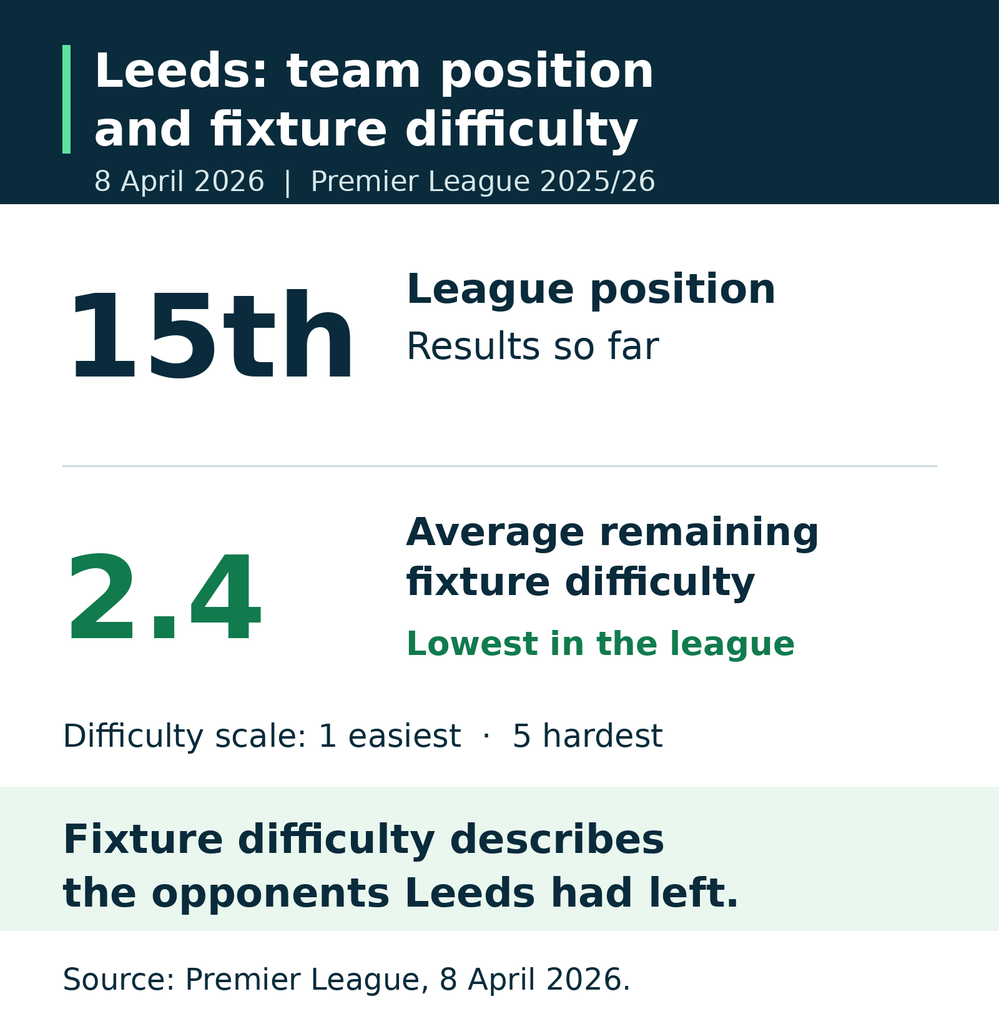
Leeds illustrated the distinction in that April snapshot. They were 15th in the league table but had the lowest reported average remaining FDR, at 2.4. That figure concerned the opponents ahead of Leeds. It did not place Leeds above Arsenal or City as a team. Their league position and favourable schedule described different sides of their situation.
Team difficulty and a player’s FPL prospects
A team assessment still needs interpretation at the player level. The opposition’s attacking strength concerns a defender’s clean-sheet prospects; its defensive strength concerns the opportunities facing an attacker. Those are separate football questions, even though both arise from the same fixture.
League position brings those aspects together within an overall results record. It does not separate attacking and defensive performance for an individual FPL comparison. An overall fixture rating is also a summary, so its usefulness depends on the question attached to it.
There is a further distinction between assessing the opponent and assessing a player’s contribution. Team strength provides context for a fixture, while a player’s involvement determines the part they actually play in it. Neither an opponent’s position nor a fixture rating supplies a complete account of that individual performance.
The April comparison left room for those different readings. Opponents’ league points described their accumulated results, while FDR assessed the fixtures ahead. An FPL player comparison then concerns the relevant part of the opposition’s game. A favourable schedule and a strong league position can inform that assessment without becoming interchangeable measures.