
Last updated on December 13th, 2025
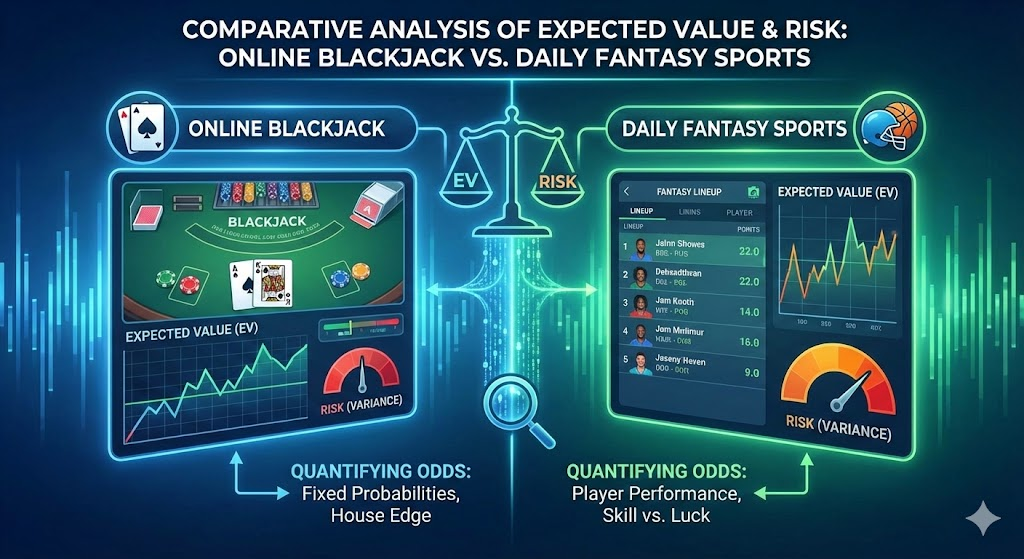
Image Credit – Gemini
Odds are an often-mentioned concept in the world of online gaming and wagering, but they are seldom discussed in their raw, mathematical format. To the analytical player, the decision to either bet at a virtual table or to create a fantasy team is not only a matter of entertainment value, but a calculation of Expected Value (EV) and structural cost and risk aversion.
Online blackjack and Daily Fantasy Sports (DFS) are two of the most popular digital speculation avenues. At a glance, they seem to be incredibly different activities, with one being a traditional casino game based on set probabilities, and the other a contemporary and peer-to-peer event based on sports knowledge. Yet, reduced to their mathematical essence, both of them are put in strict cost mechanisms that determine the long-term fate of the player.
This comparison is a strict analysis of the optimally played blackjack online and DFS. Through measuring the structural disadvantages, skill ceilings, and volatility profiles of each in turn, we can know which activity provides the better mathematical proposition to your particular financial aims.
I. The Price of Entry: Structural Costs and the Inherent Disadvantage
Each of the betting ventures has a price. It could be a casino using a portion of the action, or it could be a platform that charges a fee to host a contest; such a tax is the most important challenge a player has to overcome in order to become profitable. The basic distinction between our two competitors is the method of application of this cost and its size.
The House Edge in Online Blackjack
The price in blackjack on the internet is what is referred to as the House Edge. It is a hypothetical percentage of all the wagers that the casino is likely to retain in the long term. Significantly, this expenditure is not accidental; it is imbued in the asymmetry of the game laws (e.g., the dealer playing last).
The house advantage in online blackjack is incredibly low when a player follows a perfect strategy, which is a mathematically optimal decision-making strategy. The edge is usually between 0.5 and 2.0 percent, depending on the rule set used by the particular platform. This implies that an ideal player will lose a dollar or two when he wagers a hundred dollars. The low structural cost of online blackjack makes it one of the cheapest forms of gambling one can play, as long as they do not break the optimal strategy.
The Rake in Daily Fantasy Sports
Daily Fantasy Sports is going to be entirely different economically. Since the house does not bet against the player, it makes money by charging a commission in the form of a Rake, or a percentage of the total pool of entry fees available before a distribution of prizes.
The bottom of the industry in terms of this rake is around 10 percent. In a typical competition, when you and your opponent make a bet of 100 each, the amount bet is 200. The site collects 20 dollars, and the winner collects 180 dollars.
The difference in magnitude here is extreme. DFS’s 10% structural cost is several orders of magnitude greater than the 0.5%-2.0% cost that is present in online blackjack. This automatically puts the DFS player in a grave situation. The blackjack player is battling against a small, calculated headwind, whereas the DFS player is going up a steep hill, virtually beginning with a double-digit deficit and having to climb the hill only with abilities.
II. The Reality of Online Blackjack: A Fixed Ceiling
In case the structural cost of online blackjack costs less by a significant margin, is it the better investment? The answer is in Expected Value (EV) and limitations on the skill of players.
The Myth of Profitability
Online blackjack is analysed based on optimal play. This is on the assumption that the player makes the statistically correct decision on each hand that is dealt. However, even in such ideal circumstances, the EV is still conclusively negative.
Instead of physical casinos where card counters had the mathematical advantage, newer blackjack in online casinos involves the use of Random Number Generators (RNGs), or the live dealer version uses continuous shuffle machines. This type of technology guarantees that each hand is statistically independent of the previous one, which makes any type of advantage play, such as card counting, useless.
Therefore, online blackjack does not have long-term winning. The negative EV is fixed. It is a mathematical fact that, in the long run, the house will win its profit, in an infinitely large number of hands. Online blackjack, thus, must be considered as a pure form of entertainment cost in which the intention is not to gain capital but to maintain it.
The Impact of Rule Variations
The “cost” of entertainment in online blackjack is highly sensitive to the specific rules of the table. Two primary variables dictate the edge:
- Blackjack Payouts (3:2 vs. 6:5): This is the most important consideration. However, many online platforms have shifted to a 6:5 payout (a $12 win on a $10 bet). This seemingly minor change increases the house edge by approximately 1.39%, effectively tripling the cost of playing.
- Dealer Soft 17 (S17 vs. H17): Tables on which a dealer is required to stand on a Soft 17 (S17) are more profitable to the player. When the regulations require the dealer to strike against Soft 17 (H17), the house advantage increases by about 0.2%.
A player who chooses to play on a 6:5 table with H17 plays is effectively taking a structural disadvantage of almost 2.0% versus about 0.5% on a 3:2 S17 table. The only skill that has an effect on the bottom line in online blackjack is smart table selection.
III. Daily Fantasy Sports: The High-Skill Opportunity
Online blackjack is a bleed that is slow and guaranteed, whereas Daily Fantasy Sports will be a volatile, high-stakes battlefield. DFS is expensive initially (rake), but it has something that blackjack does not have: the probability of positive Expected Value.
Overcoming the Rake
DFS does not require you to play against a house where the mathematical advantage is predetermined, but against other people. The house is the one that gets its cut, no matter who is victorious. Thus, to be profitable, you do not simply have to be average; you have to be far superior to your competitors to pay the price of the rake.
In a standard Heads-Up (1v1) contest with a 10% rake, a player must win approximately 55.6% of their matchups just to break even.
- 50% Win Rate: You lose money (due to the rake).
- 53% Win Rate: You still lose money.
- 55.6% Win Rate: You break even.
This 55.6% threshold acts as a brutal statistical filter. With a normal distribution of player skill, the overwhelming majority of players will be clustered around the 50% win rate, i.e., most players are doomed to losing their bankroll at a slow pace in the long run.
The “Skill” Factor
However, unlike the fixed math of online blackjack, the “odds” in DFS are fluid. They depend entirely on your ability to identify inefficiencies in the market.
Academic research and professional data confirm that DFS is a game of skill. Skilled participants generate an edge by:
- Leveraging Information: Reacting faster to injury news or lineup changes than the field.
- Pricing Inefficiencies: Identifying players that the platform’s algorithm has undervalued relative to their projected output.
- Contrarian Strategy: In tournaments, constructing lineups that purposefully avoid high-owned players to maximize leverage on the field.
DFS is providing a sustainable ROI (Return on Investment) to the elite group of players, the 1-8 percent of the player pool. According to the professional standards, the best players can score long-term ROI ranging from 4 to 10 percent, and some professionals have reached 15 percent in certain niche markets. This optimistic outlook is what causes DFS to be an efficient investment tool for the most skilled, and this is what online blackjack will never be.
IV. Variance and the Psychology of Risk
The ride is another element that should be taken into consideration when selecting between these two activities is being selected. The two are radically different in their volatility profile, i.e., the way your bankroll moves up and down.
Blackjack: The Slow Burn
The game of online blackjack has low predictable variance. Due to the payouts being 1:1 or 3:2 and the likelihood of a hand winning is approximately 42-43% (without ties), the results are consistent with the mean.
A player could sit at a computerized table and spend hours taking slow, gradual hits on the chips and interspersed with minor winning spurts. The danger of losing all your bank in a few minutes is minimal when you bet a small percentage of your money. This low volatility profile goes with its position as a capital preservation activity.
DFS: The Rollercoaster
DFS, especially when there are a lot of entrants (GPPs), is characterised by excessive variance. To optimize EV in a tournament, professionals sometimes implement the so-called top-heavy strategies, which compromise the consistency for the chance of winning the tournament.
The fact of such a plan is counterintuitive and psychologically demanding. A professional DFS tournament player loses on 80% of the events that he or she participates in. Their entire long-term profit is often derived from a handful of massive scores that cover months of small losses. This “boom or bust” dynamic requires a stomach for risk that goes far beyond what is required for online blackjack.
V. Strategic Capital Management
Given these divergent risk profiles, the approach to Bankroll Management (BRM) must be tailored to the specific activity.
Preserving the Session in Blackjack
BRM in online blackjack is the survival of the session. As the long-term projection is negative, the objective is to have sufficient ammo to survive the standard deviation to play the game at a preferred length of time.
- The Rule of 100: A common guideline is to have at least 100 betting units for a session. If you are betting $10 per hand, a $1,000 bankroll ensures you are rarely wiped out by a temporary run of bad cards, allowing you to play optimally without fear of ruin.
Managing Ruin in DFS
In DFS, BRM is survival on the risk of ruin in months or years. Due to the extreme variance, the player only has to bet a very small portion of his entire bankroll on any one slate.
- The 2.5% Rule: In high-variance tournaments (GPPs), analysts advise betting up to 2.5 percent of your entire bankroll on one night.
- The 10% Rule: On the lower-variance “cash games” (Head-to-Head), the players may raise the risk to 10 percent of their bankroll.
This hardcore stake makes entry tough. In order to make substantial money playing DFS and taking the risk practice safely, a player must have a large starting bankroll to absorb the unavoidable losing sprees.
VI. Conclusion: Which is “Better”?
The comparative analysis reveals that there is no single “better” option—only an option that is better aligned with your specific goals.
1. The Case for Online Blackjack (The Recreational Choice)
Online blackjack will be a better option in case you want to be entertained, relax, and lengthen your playtime with minimal losses.
- Why: It has the lowest fixed structural cost (0.5 percent house edge on good tables).
- The Caveat: You need to follow the Basic Strategy and play at all tables with a payout of 3:2 and S17. You will have to acknowledge that long-term profit is mathematically impossible.
2. The Case for Daily Fantasy Sports (The Professional Choice)
Daily Fantasy Sports is the only option in case making money, growing capital, and testing your analytical skills are your goals.
- Why: It is a market where talent can beat the entry cost, providing the pathway to a positive EV.
- The Caveat: You face a massive initial tax (10% rake) and must possess a skill level in the top percentiles of the field to break even. You also need to have the mental stability to bear the high volatility.
To conclude, online blackjack is a cost to rent to have fun a cheap, predictable cost. DFS is a speculative investment- a high-cost, high-risk effort at creating alpha. Understanding this distinction is the first step in treating your bankroll with the respect it deserves.